May 12
10

TripAdvisor.com is a travel website that assists customers in gathering travel information, posting reviews and opinions of travel-related content and engaging in interactive travel forums.
Below are a collection of independent reviews of some hotels where LC SmartGlass is installed.

“Beautiful Rooms in the City Centre Mall”
“It’s rooms are plush with modern furniture and all of the modern conveniences including WiFi. The bathroom offers both privacy and intimacy (full bath with glass wall open to the bedroom).”
“The Best Hotel to Stay In”
“Dedicated service…modern, clean, spacious room…fantastic facilities…in the nicest mall in Bahrain. If any of these interest you, then you must stay at the Kempinski in Bahrain. The room was very modern and had all of the amenities that you would expect in a 5 star hotel. Separate shower and bath. Open window bathroom and room design with privacy glass.”
“Great Week at Kempinski”
“The bathroom was the best part ! A big bath tub , a great shower, u could get in the bath tub & watch the tv thru the glass or u could press a button & make the bathroom totally isolated ..”
“Great New Addition to Bahrain”
“Rooms are spacious and modern, and offers all the required features for a business man or for leisure. My favourite thing is the bathroom wall that can either be as transparent as glass or as opaque as milk with the snap of a button.”

“Staying in an Ipad”
“The hotel was recently refurbished and is as my husband named it, like staying in an iPad. The glazed bathroom walls, went from transparent to frosted at the touch of a button. All in all a great place to stay. A lovely experience and a nicely thought out design touch”
“Techies will love it”
“The hotel was lovely, it definitely had the wow factor. I thought the frosted glass on the bathroom that could be switched on and the tv in the bathroom were great.”
“Hidden Gem”
“Shower was amazing , bathroom is a wet room with electronic shower screen which opaques with a button press! Amazing! And a tv in the mirror!”
“A Great Experience”
“This is a fantastic hotel. It’s truly the most hi-tech hotel I’ve stayed at – with 3D TV, a bed with a massage function, an Ipad in each room, and a bathroom door that goes from transparent to frosty with the touch of a button.”
“Techie Geek Heaven”
“The design of the bathroom is very clever and the privacy glass is ingenius!”

“Smart, funky hotel with some innovative little touches”
“Stayed here for one night and was very impressed with the rooms. Great sized bed and bathroom – although it’s more of a wetroom and bathroom rolled into one. The little touches, such as the coffee maker and mood lighting made for everything that touch funkier. Smart Glass in the bathroom is a revelation….must get some installed at home!”
“Amazing!!”
“Such a nice hotel, room with smart glass bathroom and balcony is amazing”
“Wow Weeeeeeee Impressed”
“We highly recommend this Hotel. The creme de la Creme was definetly the shower with the instant frosted Glass at the press of a switch. It was wicked!”
“Great Hotel in Fantastic Location”
“Our room had a huge bedroom and equally large bathroom and was ultra-modern and sparkling clean. The bathroom had a clear glass door and when you touched a switch on the wall the Smartglass turned opaque which was amazing (my husband played with this alll evening)”
Apr 12
27
The colour, feeling and effects of natural daylight just can’t be replicated by artificial light, and yet so many offices have poor design layouts that block daylight within the office…

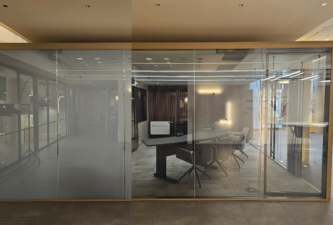
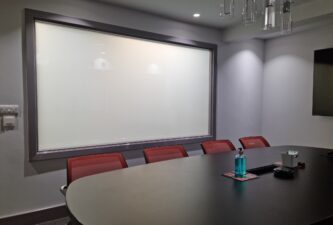
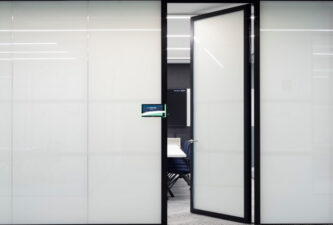
LC SmartGlass @ Pictet Bank Boardroom
Comprehensive lighting design requires consideration of the amount of functional light provided, the energy consumed, as well as the aesthetic impact supplied by the lighting system. It is important that the sciences of light production and luminaire photometrics are balanced with the artistic application of light as a medium in our built environment.
LC SmartGlass when switched “On” allows 76% light transmission & when switched “Off” allows 67%.
LC SmartGlass provides efficient utilization of space for office interiors, offering instant privacy on demand at the flick of a switch. LC SmartGlass provides simple, instantaneous and reversible states of transparency with little alteration of light level making it an ideal solution for office interiors where ample lighting is fundamental.
The quality and simplicity of LC SmartGlass provides the ideal environment of privacy for office interiors and conference rooms.
LC SmartGlass can create small subdivisions of office spaces delivering instant privacy to carry out important meetings and presentations, without distractions from onlookers, and co-workers eliminating the “goldfish bowl” effect.
LC SmartGlass offers a sleek, sophisticated interior solution eliminating the need for curtains/blinds which can look dated and unpleasant.
Light is becoming a very important design element for home and office buildings. Studies show that when people live and work in a well lit environment, they are happier, healthier and more productive.
Today, day lighting is an international trend. Natural light lifts spirits, makes spaces appear larger and lessens demands on electricity, an important factor in today’s energy – conscious world. Natural light also has been shown to reduce eyestrain, increase productivity and even decrease absenteeism in the workplace. People function better in light filled environments.
Lighting for all workers has long been a concern in many European countries. These ideas are making their ways westwards, reinforced by data showing that the rewards can extend beyond aesthetics to affect the company’s productivity and bottom line.
LC SmartGlass when switched “On” allows 76% light transmission & when switched “Off” allows 67%.

LC SmartGlass provides efficient utilization of space for office interiors, offering instant privacy on demand at the flick of a switch. LC SmartGlass provides simple, instantaneous and reversible states of transparency with no alteration of light level making it an ideal solution for office interiors where ample lighting is fundamental.
The quality and simplicity of LC SmartGlass provides the ideal environment of privacy for office interiors and conference rooms.
LC SmartGlass can create small subdivisions of office spaces delivering instant privacy to carry out important meetings and presentations, without distractions from onlookers, and co-workers eliminating the “goldfish bowl” effect.
LC SmartGlass offers a sleek, sophisticated interior solution eliminating the need for curtains/blinds which can look dated and unpleasant.
Apr 12
16
Improving the Management of Light in Museums
by Manoj Phatak, C.Eng, (C) 2011 Domoticware S.L.U

Museums tend to apply a One-Size-Fits-All approach to light management, placing entire exhibitions in semi-darkness and then using directed artificial lighting which can cause focussed deterioration on light-sensitive materials.
Instead of putting whole exhibitions in semi-darkness, why not protect just the most light-sensitive objects in darkened display cases, only illuminating them when someone is present?
Of course, this presents a question: what is the optimum ‘balance point’ between protection and exposition to light?
This article attempts to model the optimum light transmittance that a museum display case must offer in order to correctly display works of art but at the same time minimising the deterioration resulting from incident light. It is found that the optimum light exposure depends on factors such as the popularity of the art piece, the light transmittance properties of the display case and the ambient light levels in that part of the museum.

We propose using electronically-switchable (and variably tintable) SPD SmartGlass to ‘tune’ the display cabinet to the needs of each artefact.
Several solution models are presented based on CIE recommended exposure figures for light-sensitive materials and grouped by the CIE categories of light sensitive objects.
Read full article here
Apr 12
11
Yran & Storbraaten Architects (Y&S), founded in 1983, is one of the world’s leading architectural firms in the cruise vessel industry. During the last 25 years their architectural and interior design practices in the cruise industry alongside land based projects, have encompassed many large, influential projects and clients.
Yran & Storbraatens expertise in applying good sensible design philosophies, clever space planning together with radical concept development speaks for itself on a vast list of completed projects.
Less than two years ago, Viking River Cruises announced a new state of the art $250 million fleet program alongside details of its four vessels which debuted this month. Designed by architects Yran & Storbraaten, the ships, Viking Freya, Viking Idun, Viking Njord and Viking Odin, are the line’s first Longships, a new class of vessel within the Viking fleet.
Deck Plan of Viking River Longship “Odin”
LC SmartGlass is installed within each cabin separating bedroom from bathroom.

Apr 12
4
Trends and Forces Shaping the Future of the Building Skin
Pressure Brings Change…
The architectural façade has long been a compelling focus of interest for building scientists and designers alike, combining attributes of both appearance and performance in a manner unlike any other building system.
Market forces today are driving a step change in building skin technology bringing even greater attention to the façade, and increased interest across the profession, industry and the academy. Rapid climate change, unstable energy prices, depletion of easily accessible carbon-based energy resources, deteriorating economic conditions, increasing adoption of green and sustainable building practices, and urban population growth, are all among the pressures forcing change across broadening areas of global culture.
Its (almost) All About Glass
Glass has become a ubiquitous material in the building skin, a virtual commodity material, in spite of the threat it poses in extreme loading conditions (blast and impact), and its extensively documented behavior as a poor thermal and acoustical insulator.
Despite frequent predictions of a decline in the use of glass in the building façade, the trajectory remains upward, as evidenced by the latest crop of glass skyscrapers taking shape from Ground Zero in lower Manhattan to Shanghai.
Meanwhile, the debate continues: should the use of glass be prescriptively limited, or are large areas of glass required to maximize energy efficiency?
In an interview with Construction Week, Hyder’s head of electrical engineering in the UAE, Matt Jones, said, “It’s a great leap forward in the user experience of buildings, abilities of facilities managers to understand and monitor their buildings and for energy usage to be reduced.
“This is a natural progression of building design as technology progresses and in a field where there has been very little change in many years. This technology paves the way for an improved future for the complete built environment.”
Other experts agreed, alluding to a new responsibility on developers, and an emirate-wide sustainability drive, prioritised in 2009 by Dubai’s leader Sheikh Mohammed bin Rashid Al Maktoum.
“Developers have a duty of care to ensure buildings minimise energy consumption once they are operational. They need to recognise the importance of controlling energy usage and energy costs within a building in response to the escalating energy prices and the ‘green’ movement to reduce carbon emissions,” said the Sunland Group’s COO David Brown.
Nathan Hones, the general manager of Stride Treglown architects Abu Dhabi, added, “Building Management Systems are crucial to the effective operation and efficient running of buildings at various times of the day.
“With Sheikh Mohammed’s mandate that all buildings must be green back in 2009, this has put the focus firmly on developers and owners to deliver buildings that are socially responsible and sustainable.”
In Europe, where smart buildings were first conceptualised, it is still the case that only 10% of buildings have efficient and effective controls.
In the Middle East, there continues to be very few smart buildings, but contractors and suppliers say that number is increasing, with projects like Le Rêve in Dubai, the Yas Marina hotel in Abu Dhabi and the Waseel Tower and Mövenpick in Riyadh all completed in recent years.
Inefficient windows are responsible for thousands of dollars in energy loss for both residential and commercial property owners. But new smart glass technology could allow windows to control sunlight and heat, drastically reducing energy costs across the country.


…you wake up in the dark hours of an early winter morning, but instead of flipping on the lights, you flip a switch that sends a tiny electric current through the electrochromatic glass of your windows. The windows instantly turn from dark to transparent, allowing the warmth and natural light of the sun to flood your home.
Now imagine this: you’re the office manager of a company in scorching hot Phoenix, Arizona. Instead of cranking up the air conditioning when the sun warms the windows of your office to over 100 degrees, you simply flip a switch. Instantly the smart glass windows of your office building become tinted, blocking out the sun and helping to maintain a cooler temperature inside.
Now, you might be wondering how installing electrified windows is going to help buildings reduce their energy consumption, rather than increase it. Ultra-efficiency is the answer: Experts say that powering 2,000 square feet of the color-changing glass—the equivalent of more than 100 windows—would require less power than illuminating a 60-watt light bulb.
SPD-SmartGlass by SmartGlass Interational can be manually or automatically “tuned” to precisely control the amount of light, glare and heat passing through a window. While glass is often a favored product for use in building facades; glare, solar heat gain and UV exposure are problematic and can often make the use of glass impractical resulting in the need to invest in expensive solar shading devices.
Glass facades using patented SPD solar control technology reduce the need for air conditioning during the summer months and heating during winter. The ability to instantly switch the glass to maximize daylight when it’s really needed and to provide controllable solar shading during peak light conditions is valuable and unique to SPD SmartGlass. All SPD SmartGlass panels are bespoke manufactured using a lamination process which encapsulates a SPD “Suspended Particle Device” film between 2 or more glass sheets.
So how does it actually work? When the power supply is switched on, the rod shaped suspended particle molecules align, light passes through and the SPD SmartGlass panel clears. SPD SmartGlass protect from damaging UV when on or off.
When the power supply is switched off the rod shaped suspended particle molecules are randomly oriented blocking light and the SPD SmartGlass becomes dark blocking up to 99.4% of light.
The Saudi Arabian government has taken the drive towards more sustainable construction to heart with the completion of its first Smart Building that will act as the headquarters of the ministry of higher education in Riyadh.
The idea of hotels offering large, luxury bathrooms that offer more than just bathing is a fallacy, according to designer and architect Matteo Thun.
“In hotels, the talk is always of living bathrooms or of luxury bathrooms offering more than just bathing. However, this take on luxury bathrooms is a fallacy,” said Thun, who has recently designed the new Onto bathroom series for Duravit.
“Bathrooms in hotels are not getting bigger, they remain small spaces. If you want to integrate them into the living or sleeping area, you simply have to take down the walls. With the exception of the toilet that, for reasons of hygiene, should remain a self-contained room,” said Thun.
He added that keeping bathrooms small does not impact negatively on the guest experience.
“The guest’s main concern is a great shower – and the concept I’ve just talked about offers more than enough space for that!” said Thun.
He explained that the most important consideration for hotel bathroom design was “water and the pleasure that can be had from it”.
“This doesn’t actually mean using more water, but incorporating the fascination of a dynamic element. For this reason, we avoid sharp corners and edges so that the individual can move around freely and instinctively wearing nothing but his birthday suit.
“Hygiene and cleanliness are of fundamental importance – which is why we stopped working with tiles more than 25 years ago,” said Thun.
“Another very important element is light — every bathroom should have natural light — and nothing but indirect light sources,” he asserted.
In terms of trends for design in the future, Thus predicted that the high-tech trend will take a back seat in the coming years.
“Low-tech and individuality will be the order of the day,” Thun said.
Mar 12
16
Review of New Court Building By Rowan Moore
“Rothschild is one of the world’s most august financial institutions, reflected in its discreet yet opulent new City HQ designed by Rem Koolhaas’s OMA”

The City of London is, in its own special way, surprisingly fond of architecture. You might have thought that niceties of design would get in the way of its relentless contest with other financial centres to be the most fearsome money machine in the world, but no. The rulers of the City permit themselves the incredible luxury, inconceivable in Singapore, Shenzhen or even Canary Wharf, of weighing and deliberating every tweak of its fabric.
There are the historic buildings, the monuments of Wren, Hawksmoor and Lutyens, that are reverentially coddled. There are also the monuments of the masters of our own time, as recognised by the biggest architecture award in the world, the Pritzker prize. There are works by no fewer than five winners of the prize (Norman Foster, Richard Rogers, Jean Nouvel, James Stirling and Rem Koolhass’s practice OMA) within the Square Mile. A sixth, Renzo Piano’s Shard, makes its presence felt from just outside its boundaries. Such concentrations are hard to find outside places such as Saadiyat Island, the instant cultural district under construction in Abu Dhabi, or the 1980s tea services designed for the Italian company Alessi, by the biggest stars of the time.
The latest addition to the collection, OMA’s whitish tower for the financial advisory group Rothschild, has ghosted its way on to the skyline with a surprising degree of discretion. Usually every sneeze of Rem Koolhaas and his team is the object of global fascination by architects and followers of architecture, but this not-small building has been sitting there for some time, its exterior more or less finished, without anyone paying much attention. Now the interior fit-out is also complete, bar a few details.
The discretion is part of Rothschild’s corporate personality. As a distinguished 200-year-old institution, it doesn’t feel the need to shout. It doesn’t put its name on the door, and while it hangs a coat of arms outside, reused from former buildings, this is not very communicative to non-students of heraldry. It is located in a lane of extraordinary narrowness a short distance from the Bank of England, a narrow strip of pitted tarmac that seems one remove from being a cart track. You are supposed just to know that it is there and if you don’t, you are not someone who needs to know or whom it needs to know.
You do, however, know that you are in the presence of something with a high degree of self-confidence. From the lane you rise through a steel colonnade to an ample podium of perfect emptiness, the main body of the building overhead, which then opens on to an also ample reception area. You are treated to the luxury of sheer space, precisely delineated with the oblong architecture. The floor is of travertine, also the ceiling, which creates a vertiginous blurring of up and down. Off to one side is an oak-shelved library that will house the Rothschild archive.

‘Sheer space’: the reception area. Photograph: Philippe Ruault/OMA
Should you be allowed past the security barriers you can then rise through the building, past the gym and cafe, and floors of close-packed desks, to the top levels of meeting rooms, dining rooms and events suites. There is a quasi-Soviet collectivism about the way the place is organised; as in the 1920s Narkomfin housing project in Moscow, the space allotted to individuals is modest, but the shared spaces of exercise, eating and meeting are generous.
In these spaces, an ever more magnificent panorama unfolds. In one direction St Paul’s Cathedral sits in mighty repose, placed in the middle of a glass wall as if it were put there for the special benefit of Rothschild. In another there are the Gherkin and other towers of the City, which somehow look more impressive and serene than they do from ground level. These are celestial, Olympian spaces that convey the certainty that this – here, at this elevation, in this part of London – is where Rothschild belongs.

‘As if it were put there for the special benefit of Rothschild’: the view of St Paul’s Cathedral. Photograph: OMA
It is not all about sheer pomp and prestige. This is not OMA’s way, and running through the building are touches of wit, irony and teasing. There is a play of small and big, which starts with the transition from lane to podium and continues with such things as extra-heavy or extra-light handrails. There are very thick walls (“Like castles and palaces,” say OMA) and very thin ones made of glass.
There is also a play with the history of which Rothschild is so proud. In the meeting rooms are ancestral portraits, of well-mounted men riding to hounds and such like, and antique furniture. These are placed, with a touch of the eclecticism of a boutique hotel, alongside glass and aluminium, the latter embossed, in another moment of old/new overlay, with woodgrain patterns from the old oak panelling.

‘The interplay of oak, oil paint, silk and aluminium is where all the fun is to be had.’ Photograph: OMA
In Richard Rogers’s Lloyd’s Building a Robert Adam interior, imported from the institution’s earlier premises, was recreated. There, it is a touch embarrassing in relation to the high-techery around it. In Rothschild the interplay of oak, oil paint, silk and aluminium is where all the fun is to be had. It delivers the required message that the institution is both ancient and modern. More than that, it is shown to be cultured, sophisticated, self-aware and sufficiently self-assured to allow a little humour. Rothschild advises but doesn’t lend, which sets it apart from the casino banks of ill-repute, and its architecture reminds you of this fact.
OMA also likes to squeeze whatever public value there might be in a commission, even out of a discreet private bank. The colonnade along the lane can be used by anyone, in effect widening the street, and on the far side of the podium a view opens up to the churchyard of Wren’s St Stephen Walbrook. It is clear that the podium is privately owned space, but the building still offers more than the many City blocks which rise sheer and opaque from the pavement. Next door, for example, one of Foster’s least good works has been squelched on to the ground, an assertive, ribbed, over-inflated blob that is oblivious to its surroundings. OMA’s building interacts with its neighbours, enriching itself and them in the process.
The City’s fondness for architecture has, in fact, its limits. Often it runs as far as licensing a big name to sculpt the external form of a block, but not to such architectural qualities as the play of volumes and scale, the interconnection of outside and in or the creation of three-dimensional settings for the lives that go on in and around a building. Rothschild does all these things, with skill and subtlety. The only shame is that some of the best bits are on the far side of the security barriers. Come the revolution, though, it will make a great collectivist housing scheme.
Hilton Dubai Jumeriah – Winner of “Best Sustainable Hotel of the Middle East” at the annual Middle East Hospitality Expansion Congress
Is green the new black in the world of hospitality and can hotels push the boundaries of sustainability while keeping costs low?
Kathi Everden assesses the extent of environmental measures underway in the Middle East hotel sector…
“Many hotel chains globally have set carbon reduction targets,” said WTTC president, David Scowsill. “Through this initiative the industry is furthering its commitment to corporate and individual consumers by helping them to understand their carbon footprint.”
And, while not located locally, it is heartening that the first carbon neutral hotel worldwide is the Emirates’ owned and operated Wolgan Valley Resort & Spa in Australia, certified as such for the second year when it achieved a surplus of carbon credits.
The resort capitalised on sustainability practices at Al Maha in Dubai, arguably the first green hotel in the region, and was nominated by WTTC as an outstanding case study in the blueprint for future eco-friendly tourism.
Overall, however, the regional hospitality sector has been slow to adapt green principles, even down to the very natural conversion to solar power that the climate might have mandated.
“The Middle East does have some catching up to do when compared to more developed markets, and it’s incredibly important that all government and big corporate organisations commit time and resources to improve on the green initiatives in the region … but it is changing, and at Rezidor we hope we are leading the way,” says area VP, Marko Hytönen.
Not only is sustainability a win-win situation — saving both energy and money — but it is increasingly necessary as consumers are demanding proof of sustainability credentials.
A recent survey by TUI Travel in eight major markets revealed that one in two holidaymakers would book a more sustainable holiday if it were readily available, while two in three would change their behaviour while away if it helped the environment.
As a result, TUI UK, for instance, has set a target for 90% of the hotels that are featured in its holiday programmes to be Travelife certified by 2014.
A survey by TripAdvisor in the US, meanwhile, revealed that nearly half of respondents would take eco-friendly factors in to consideration when making travel plans and a MindClick SGM survey of members of the Association of Corporate Travel Planners revealed that 65% were in various stages of implementing green business travel guidelines.
Of the major European chains, Accor claims to be in the forefront of the green movement, winning the WTTC’s 2010 Tourism for Tomorrow Award for its global sustainability strategy as well as a fistful of other recognition following its Earth Guest programme set up five years ago.
“Our Accor Environment Charter is very much part of our commitment to owners and investors in the region, comprising 65 actions that hotels are doing to reduce their environmental impact — we work hand in hand with owners during construction to propose tailor-made tools and eco-friendly solutions which result in huge energy savings — retrocom audits can also improve energy performance and require no investment,” says regional managing director, Christophe Landais.
Accor is also moving to offer green meeting options in its regional hotels, while Landais says it is already able to provide corporate customers with precise results on their carbon footprint when guests are booking a room night or organising a meeting.
Interestingly, the group is also incentivising its GMs to reach green standards: “Those who achieve or surpass set objectives such as energy saving platforms are given additional monetary compensations,” says Olivier Hick, director of operations Accor ME, explaining that all the Pullman and Novotel hotels are aiming to have EarthCheck certification by next year.
Another chain majoring on certification is Mövenpick, moving fast in the Middle East with all of its 23 hotels here aiming for Green Globe status by the end of the year.
“Generally, the total cost of certification varies between $8000 to $12,000,” says regional VP operations, Gerard Hotelier.
“The certified properties are definitely benefiting by achieving substantial operational savings, and also will answer needs of both corporate and leisure business.”
Cost savings have been underlined by Farnek Avireal which has a five-year Middle East licensing agreement with Green Globe and is assisting properties to meet the 248 standards set out by them.
“All Mövenpick hotels have access to our energy benchmark auditing system which uses internet-based software ‘hotel optimiser’ to calculate CO2 emissions,” says Farnek Avireal general manager, Markus Oberlin, who pointed out that hotels in the region traditionally produced double the amount of CO2 emissions compared with European properties, while using nearly triple the amount of water per guest.
“We estimate that a hotel such as the Mövenpick Tala Bay, for instance, could reduce its carbon emissions by more than 6,250 tonnes annually, while reduced energy consumption could save an average 250-bedroom hotel around $5 per room-night.”
At the Mövenpick El Gouna — recognised by Kuoni-Apollo as the most ‘sustainability conscious’ hotel in its programme — general manager John Wood says that the attitude of developer Orascom has been instrumental in assisting with green initiatives.
Government support
A variety of tourism boards are now pushing hotels to deliver green credentials. Abu Dhabi has prioritised green standards as a USP for its evolving tourism product, with the Abu Dhabi Tourism Authority mandating all hotels and hotel apartments to operate under an over-riding Environment, Health and Safety Management System (EHSMS) with targets for reduction in energy and water consumption (10% and 20%) and the waste sent to landfill (20%).
According to ADTA tourism standards director, Nasser Al Reyami, sustainability is now an essential part of the world-class tourism experience: “Abu Dhabi’s challenging climate coupled with its emergence as a high-end tourism destination provides us with an excellent opportunity to develop our own environmentally-responsible tourism offerings,” he says. “Sustainability is part of our strategic vision.”
As well as an in-house team to supervise development in this area, ADTA has conducted a series of Green Hotel workshops to showcase best practices, assisted with retraining of hotel staff in environmentally-friendly work practices, and will now be looking at other areas including the operations of desert camps.
All hotels will be ranked for their green credentials but new properties will be ahead of the game with opportunities to build in sustainable operations.
At the new Park Hyatt Abu Dhabi, general manager Stuart Deeson says architects implemented many features at the design stage so that green standards were naturally part of the hotel: “Through adoption of green building guidelines, we have been able to set benchmarks that only a few existing hotels can meet”.
The hotel is one of the few properties in the final stage of becoming an LEED-certified luxury hotel — among its green features are the use of natural light through skylights in 75% of the building; capture of prevailing winds for ventilation; 50% dry wadi landscaping to reduce water consumption; coated double glazing to cut heating and cooling loads, and solar panels which cut energy costs by 75%.
“These sustainable measures will pay us back in the long-term, not only in reduced water and energy costs but increased interest from today’s discerning travellers — our global accounts are telling us their goal is to find a hotel company with green initiatives in place,” adds Deeson.
“Good ventilation and natural light are factors in improved worker productivity”
Joel Quintal, Sustainability Director – Jones Lang LaSalle
Green Building and Workplace Productivity
While green buildings are often touted for their lessened impact on the environment and reduced cost over time, green and/or LEED certified buildings, designed for a high level indoor environmental quality have an added benefit: increased worker productivity. Examples of worker productivity indicators are increases in perceived satisfaction and comfort, reduced sick days and an increase in the number of billable hours versus average time spent at work.
There are many studies that demonstrate that green buildings improve worker productivity, as proven by these indicators…
In an article entitled “Building the Green Way” in the June 2006 Harvard Business Review, Charles Lockwood stated, “green design criteria – including abundant daylighting, individual climate controls, and outdoor views – raise morale and employee satisfaction, which also improves productivity”. The Genzyme Center, which is Genzyme Corporation’s LEED Platinum headquarters, was touted as an example: When 920 employees moved from the former headquarters to the new green office space, 58% reported increased productivity. Sick time decreased by 5% compared to Genzyme’s other office spaces.
Worker Productivity After a Building Retrofit
Similarly, “Employee Productivity in a Sustainable Building”, a study commissioned in Australia by Sustainability Victoria and the Kador Group, analyzed employee productivity at Kador’s 500 Collins Street before and after the building underwent substantial green retrofits and earned a 5 Green Star Rating for Office Design.
Comparatively, employees in the new building experienced:
- 39% fewer sick days per month
- 9% improvement in secretaries’ typing speed and significant gains in typing accuracy
- 7% increase in billable hours despite 12% decline in average monthly hours worked, meaning that productivity during hours worked increased
The employees at 500 Collins Street also perceived the office to be more comfortable, reporting higher satisfaction with the new office, higher perceived fresh air and increased perception of thermal comfort and lighting quality. In fact, 40% of the employees found the new office “invigorating” compared to the old office.
Daylighting, Ventilation and Worker Productivity
In a 2003 Carnegie Mellon University study, Professor Vivian Loftness demonstrated the importance of natural light and air to worker productivity. The study showed a 3-18% gain in productivity in buildings with daylighting systems, which increase natural light. Similarly, the study showed a 0.4-7.5% gain in building environments with natural ventilation and/or access to the outdoors.
The study also showed that controllability of systems for thermal comfort and lighting was important to productivity. In buildings with individual temperature controls, there was a 0.2-3 percent increase in productivity. The study also quoted other research, which demonstrated that both underfloor and desktop user-controllable/task air systems increased individual productivity by 11%.
But Doesn’t Indoor Environmental Quality Use Energy?
There is a misconception that improving indoor environmental quality uses (more) energy, but as shown in Loftness’ study, “the goal of improving indoor environmental quality is actually proving to measurably reduce energy and other environmental costs, and to dramatically improve business performance”.
Indoor Environmental Quality and LEED
If you are interested in greening your office space to improve worker productivity, the Leadership in Energy and Environmental Design (LEED) green building rating system may serve as a useful design tool. Specifically, LEED has a credit category called “Indoor Environmental Quality” with helpful design guidelines that address indoor air quality, ventilation, low-emitting materials, controllability of lighting, thermal comfort, and daylighting and views.
SPD SmartGlass was designed to maximise the use of natural daylight in buildings to improve the well-being of the people within. The use of SPD SmartGlass on commercial projects can help you achieve up to 8 LEED certification credits.
What makes SPD SmartGlass a sustainable building product?
Buildings are the largest source of energy consumption in the world, and energy lost through today’s inefficient windows accounts for 30% of the building heating and cooling energy consumed in the U.S. SPD SmartGlass is significantly more energy efficient than static glazing, providing a comfortable interior for occupants with an uninterrupted view as the need for blinds/curtains is eliminated. SPD SmartGlass provides a sustainable eco-friendly building interior whilst also enhancing the corporate image of the building.
Sustainable Sites
Energy and Atmosphere
Indoor Environmental Quality
SPD SmartGlass has proven itself in testing conducted by Cambridge University in a number of different worldwide simulated climate conditions. These include locations such as Dubai and Houston, Texas, which are associated with very heavy cooling loads. In both locations SPD SmartGlass showed identical solar heat gain reduction. Due to energy consumed by HVAC systems in these hotter climates the savings in cooling loads by using SPD SmartGlass can be up to 65% of associated energy costs.